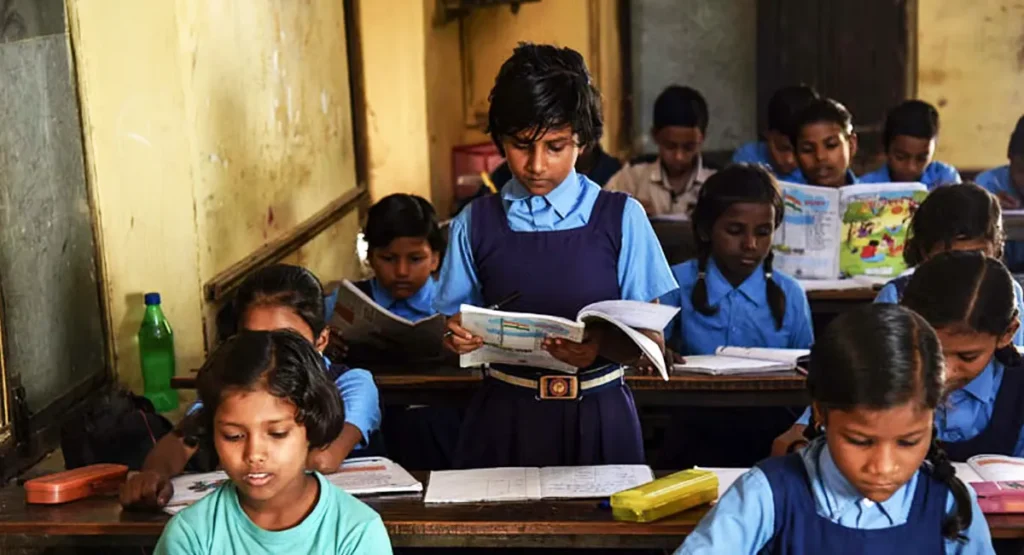
In the bustling lanes of Noida’s slum clusters, you will find children with books tucked under their arms, walking barefoot yet determined to reach school. These children carry more than their textbooks—they carry dreams, resilience, and the hope that education will change the trajectory of their lives. But education alone cannot sustain them. A hungry child struggles to concentrate, to retain lessons, or even to sit through the school day. School nutrition in Noida, therefore, is not a supplementary need—it is the foundation upon which education, empowerment, and equality are built.
Across India, the intersection of nutrition, education, and women’s empowerment has proven to be transformative for underprivileged communities. From mid-day meals that keep children in classrooms to skill-training initiatives that enable women to support families, community-led programs are rewriting stories of deprivation into narratives of dignity. This blog explores how nutrition drives education outcomes, why women play a central role in this ecosystem, and how local NGOs in Noida—including initiatives like One Hand for Happiness meals—are lighting the way forward.
Imagine trying to solve math problems on an empty stomach. Studies show that hunger directly hampers cognitive development, memory retention, and concentration. For children in Noida’s underserved neighborhoods, where daily meals are not guaranteed, attending school without food often means education remains a distant promise rather than an empowering reality.
Nutrition and learning are not separate silos—they are interdependent forces. For underprivileged children education, a healthy plate of rice, lentils, and vegetables is often the difference between dropping out and dreaming big.
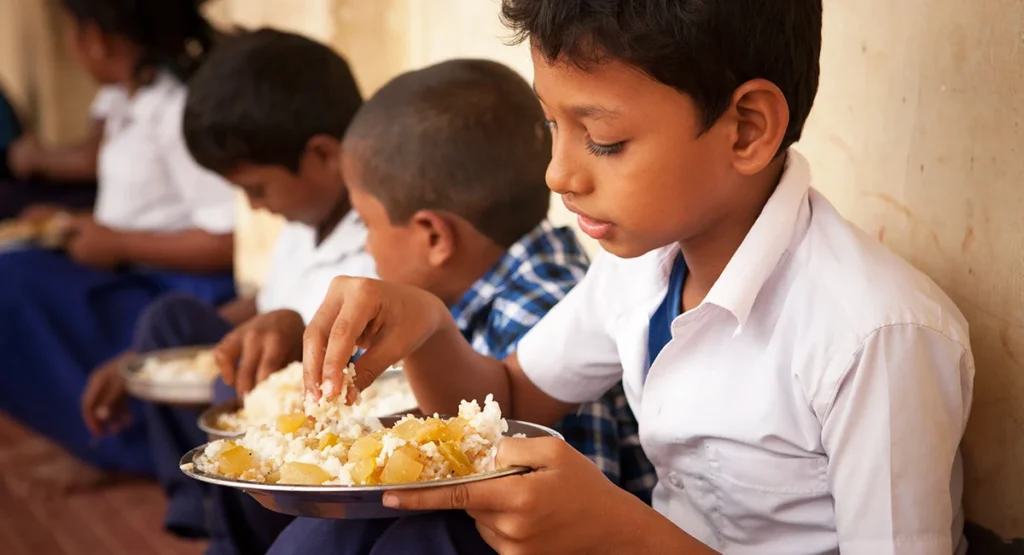
In Noida’s slums, where many families survive on daily wage labor, the promise of a hot mid-day meal acts as both an incentive and a lifeline. Parents struggling to feed their children view school as more than a place of learning—it becomes a space of survival and hope.
This is where the quiet yet powerful work of an education NGO in Noida comes in. By ensuring meals alongside books, uniforms, and stationery, NGOs transform schools into holistic centers of growth. The One Hand for Happiness meals initiative is one such effort, ensuring that no child sits through class hungry. While the plate fills their stomachs, it also fills classrooms with laughter, energy, and the possibility of brighter futures.
The impact of these meals is profound:
Mid-day meals thus serve as a bridge—pulling children out of the cycle of malnutrition and placing them firmly on the path of learning.

When we talk about school meals, we must also talk about the women behind them. In most community-driven programs, it is mothers or local women who cook and distribute food. This creates an empowering cycle:
The story of Rekha, a mother from a Noida slum, illustrates this beautifully. Once confined to household chores and uncertain earnings, she now works as a cook for a kids welfare NGO. With the modest income, she not only funds her daughter’s school fees but has also learned financial literacy through skill-based workshops. Rekha describes the pride of seeing her child study with a full stomach as the “greatest return” of her work.
This demonstrates how nutrition drive Delhi NCR initiatives not only combat hunger but also strengthen women’s agency. When women are empowered, children thrive, and communities evolve.
Education is often hailed as the most powerful tool to break the cycle of poverty. But for children in Noida’s slums, it comes with barriers: lack of school supplies, absence of role models, and the pressing need to contribute financially to the family. Here, NGOs step in—not as charity providers but as partners in dignity.
An NGO for children in Noida that integrates meals, mentorship, and material support doesn’t just create students—it nurtures future leaders, workers, and responsible citizens.
Across India, countless stories testify to the power of mid-day meals. In Tamil Nadu, the pioneering state of the mid-day meal scheme, school enrollment skyrocketed in the 1980s, especially for girls. In Rajasthan, studies found that anemia rates among schoolchildren dropped significantly after nutrition programs were introduced.
In Noida’s slum communities, similar results are emerging through child education NGO India initiatives:
These stories humanize the statistics. They remind us that interventions are not just policies but lifelines that alter destinies.
The ripple effects of school nutrition extend beyond classrooms. They touch entire communities:
This synergy creates a cycle where education fuels empowerment, nutrition fuels education, and empowerment fuels community development. In essence, it builds a stronger, more resilient nation—one school plate at a time.
Among the many grassroots efforts in the region, One Hand for Happiness meals stands as a quiet yet impactful model. By combining education support with nutrition and women’s empowerment, it exemplifies how holistic interventions can uplift an entire generation. Though small in scale compared to national schemes, its model of delivering meals, books, and uniforms, while also engaging women in skills programs, reflects the essence of community-driven change.
It is a reminder that solutions need not always be grandiose. Sometimes, the difference between despair and hope is as simple as a warm plate of dal and rice served at the right time.
Despite progress, challenges persist:
Addressing these requires policy commitment, community participation, and sustained NGO involvement.
To truly transform lives, future strategies must blend nutrition, education, and empowerment seamlessly:
Such models are not just about alleviating hunger—they are about restoring dignity and creating opportunities for underprivileged communities.
As the afternoon bell rings in a slum school in Noida, children line up for their mid-day meal. For many, it will be the only substantial food they eat that day. Yet, as they eat, their chatter is not about hunger—it is about the science experiment they just did, the poem they memorized, or the cricket match they plan to play.
This is the true power of nutrition—it frees the mind to dream. It transforms classrooms into spaces of possibility. It empowers mothers, uplifts families, and reshapes communities.
Underprivileged children education cannot thrive on books alone—it needs nourishment, both of the body and of the soul. When kids welfare NGOs and communities in Delhi NCR come together with initiatives like One Hand for Happiness meals, they do more than serve food—they serve hope, dignity, and the foundation for a brighter tomorrow.
The path is long, but every warm meal placed in front of a child brings us closer to a world where education is not a privilege but a promise fulfilled.


Leave A Comment