In the bustling classrooms of urban slums and the sunlit corners of rural schools, something magical happens when a child is handed a pencil for the first time. It’s more than just stationery—it’s a symbol of possibility. A piece of paper becomes a canvas. A crayon becomes a language. A pen becomes a voice.
This is the story of how access to school supplies isn’t just about notebooks and erasers—it’s about nurturing potential, confidence, and imagination. In underserved communities, where access to basic learning tools is limited, a small intervention like the donation of school stationery can unlock doors to self-expression, academic growth, and even future leadership.
Imagine being a child in a classroom without a pencil. Every lesson becomes a hurdle. Every answer you know but can’t write down becomes a missed opportunity.
For thousands of underprivileged children across India and the world, this isn’t just imagination—it’s daily reality. According to UNESCO, 258 million children globally were out of school in 2022, and among those who attend, many lack essential school tools like writing materials.
Stationery empowerment goes beyond just meeting logistical needs—it enhances writing confidence, encourages child expression, and bridges the gap between student creativity and achievement.
It’s easy to underestimate the role of a pencil, but for a child in a low-income setting, having their own pen or notebook instills a sense of ownership and belonging. When a child owns learning materials, they no longer feel like an outsider looking in—they feel like they belong in the classroom.
Research by the Brookings Institution shows that students with access to appropriate school supplies score higher in academic assessments and report better emotional engagement in class. School becomes a place of joy, not anxiety.
Providing tools for education helps boost:
Stationery is often the first medium through which a child expresses what they think and feel. Be it a doodle in the margin of a notebook or a poem about their village, writing and drawing are emotional outlets for children living in challenging environments.
NGOs working on the ground, like One Hand for Happiness, have witnessed first-hand how a sketchbook can be more powerful than a therapy session. It gives children a chance to dream out loud and process their experiences constructively.
In a government school in Madhya Pradesh, a writing workshop equipped underprivileged students with journals. A month later, one girl, age 11, had written seven short stories—stories that centered around strong, brave girls who rescued others from danger. When asked why she wrote those stories, she simply said:
“I want to become someone like them, someone who helps.”
That’s the quiet revolution school supplies can start.
In areas where underprivileged education suffers due to lack of funding and infrastructure, initiatives that provide learning materials like stationery, books, and uniforms can level the playing field.
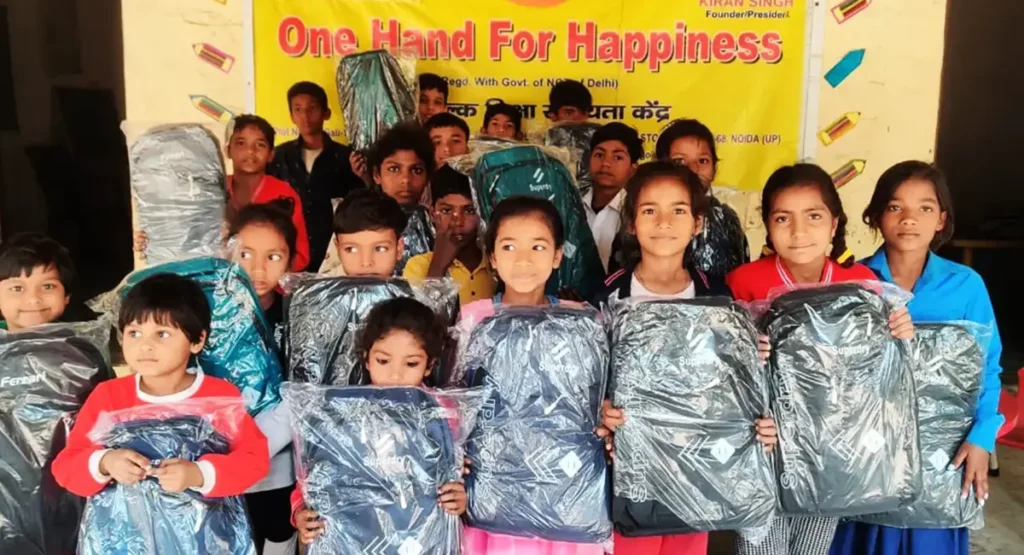
The role of stationery becomes more critical in regions where parents are daily wage workers and can’t afford school bags, let alone pens. NGOs and community-driven efforts that distribute school supplies ensure that no child is left behind because of a missing notebook.
A survey by Pratham’s ASER report found that availability of writing tools correlated positively with reading and arithmetic skills—not just because of the tools themselves but because they motivate children to attend and participate in class.
Here’s where the cycle comes full circle: many NGOs design their stationery donation drives as women empowerment programs. Women from underprivileged backgrounds are trained in packaging, printing, or even stitching school kits.
Such skill-building women initiatives do two things:
This micro training approach uplifts women and enables them to directly invest in their children’s education. Over time, these women become role models for younger girls, sparking a chain of empowering kids and communities.
The availability of stationery also aids in inclusive education for children with learning disabilities or from marginalized communities. Customized notebooks with visual prompts, tactile pens for visually impaired students, or bilingual exercise books all play a role in making education accessible, adaptive, and equitable.
For example, in Rajasthan, specially curated sketchbooks with bold lines and pictorial prompts helped non-verbal students develop emotional literacy. These students, who often sat silent in class, started expressing joy, confusion, even sadness—just through drawings.
While governments provide mid-day meals and free textbooks, stationery items often fall through the cracks. This is where community-backed initiatives step in.
Organizations such as One Hand for Happiness collaborate with local volunteers and donors to distribute stationery kits to government schools, slum clusters, and shelter homes. These kits don’t just include pens and notebooks—they include dignity and hope.
Each distributed school kit is a message to the child: “Your education matters.”
And every time a woman from the community helps assemble these kits, it says: “Your work has power.”
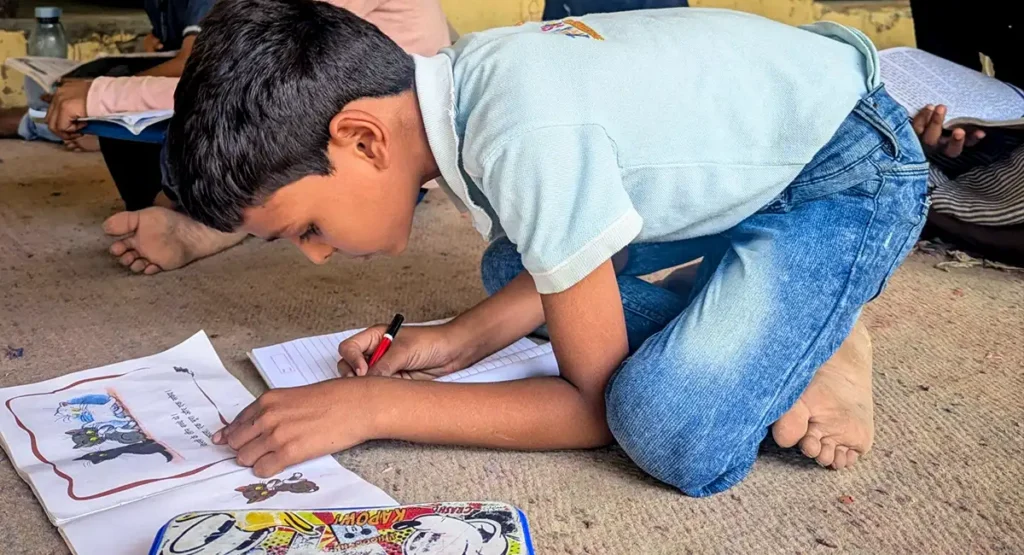
In an age where digital tools dominate, there’s still unmatched value in paper, pencil, and imagination. Children in underserved areas don’t ask for iPads—they ask for the basics. And when those basics are provided, the transformation is profound.
In a slum in Delhi, an art teacher noticed a sudden burst of creativity when students received colored pencils in class. One boy who had been disinterested and quiet began sketching the local park every day. By the end of the semester, he had created a full illustrated book. His teacher said:
“We always thought he was slow. Turns out, he just didn’t have tools to express himself.”
That boy now dreams of being an animator.
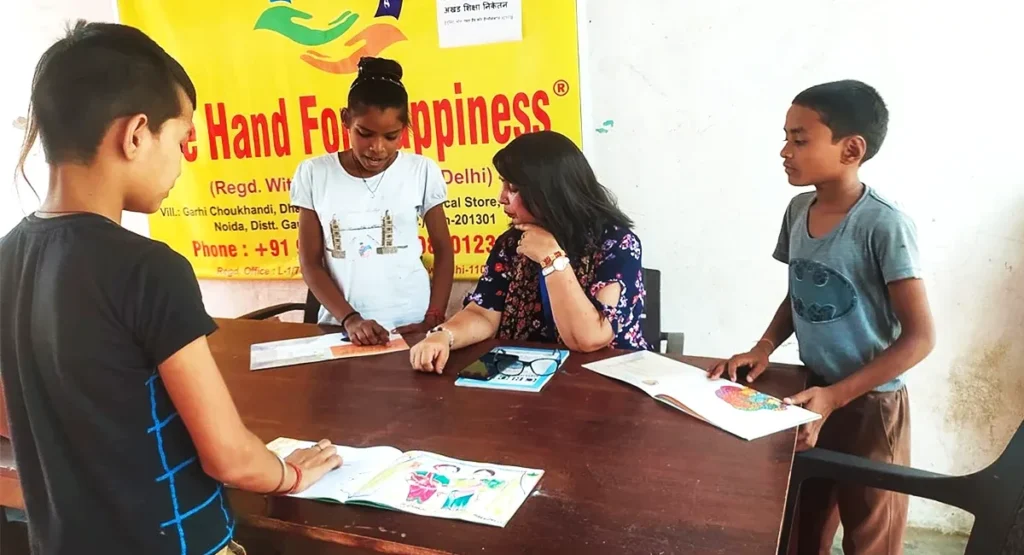
True empowerment doesn’t come only from policy—it comes from consistent, grassroots-level support that meets communities where they are. When women are trained to support education drives, and children are given stationery, books, and meals, the results are generational.
Such layered efforts—education, nutrition, and skills—form a cycle of care that helps entire communities rise.
And it all starts with something as simple as a sharpened pencil.
While systemic reform takes time, impact starts with intention. Here are small ways individuals can help:
Stationery may seem small, but its impact is mighty. It gives children more than a way to complete homework—it gives them a voice. It fuels dreams, boosts confidence, and creates joyful learners.
When a child receives their first notebook, it’s not just a page—it’s a future waiting to be written.
As communities, NGOs, and compassionate individuals come together—like One Hand for Happiness and others—the potential of every pencil, every sketchbook, every eraser is fully realized.
Because sometimes, all it takes to go from zero to hero… is a pen.

Leave A Comment